The Knights Who Never Disappeared: How the Templars Survived in Portugal
Across Europe, the Knights Templar were arrested, persecuted, and officially dissolved. In Portugal, however, their story followed a different path. Protected by King Dinis, their legacy was transferred to the Order of Christ and later became connected to the voyages that carried Portugal across the oceans.
By Lisbon Gems Tours
On Friday, 13 October 1307, the Knights Templar were arrested across France.
Accused of heresy and other crimes, the once-powerful military order became the target of King Philip IV of France. Its members were interrogated, its property seized, and its reputation surrounded by allegations that would inspire centuries of legends about secret rituals, hidden treasure, and forbidden knowledge.
In 1312, Pope Clement V formally dissolved the Order.
In much of Europe, the story of the Templars appeared to be over.
But not in Portugal.
The knights who helped build a kingdom
The Templars had arrived in Portugal during the 12th century, when the young kingdom was still fighting to establish its territory.
They supported Portugal’s first kings during the Christian Reconquest and received lands in return. Under the leadership of Gualdim Pais, one of the most important Portuguese Templars, they founded the Castle of Tomar in 1160.
The fortress was not merely a military base. It became the headquarters of the Order in Portugal and one of the most advanced defensive structures in the kingdom.
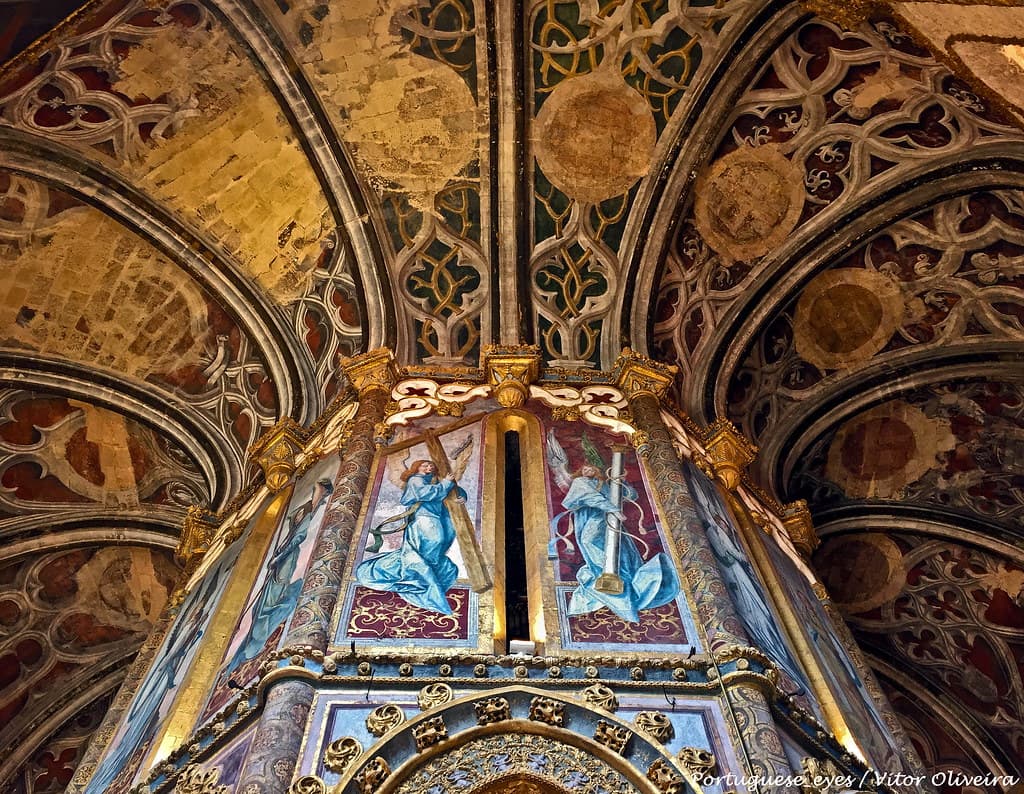
At its centre stood the Charola, a circular Templar church inspired by the Church of the Holy Sepulchre in Jerusalem. Knights could reportedly attend religious services while remaining mounted, ready to defend the fortress at any moment.
Tomar became their spiritual and military heart.
King Dinis chooses a different path
When the Templars were abolished, Portugal’s King Dinis did not simply surrender their lands and resources.
The Portuguese Templars had played a decisive role in defending and consolidating the kingdom. They were valuable soldiers, administrators, and landowners. Destroying their entire structure would have weakened Portugal.
King Dinis began negotiations with the papacy.
In 1319, Pope John XXII approved the creation of a new Portuguese military order: the Order of Christ.
Former Templar possessions were transferred to it, and many of the traditions, resources, and perhaps members of the old Order continued under the new name.
The red Templar cross was replaced by the distinctive cross of the Order of Christ—but the connection between the two organisations remained unmistakable.
The Templars had not officially survived.
Yet their Portuguese legacy had been transformed rather than erased.
From crusaders to navigators
The most extraordinary chapter came more than a century later.
Prince Henry the Navigator became governor of the Order of Christ in the 15th century. Under his leadership, the Order’s wealth and organisation became associated with Portugal’s early maritime expansion.
Portuguese ships sailed along the African coast, searching for new commercial routes and territories. The cross of the Order of Christ appeared prominently on their white sails.
It became one of the most recognisable symbols of the Portuguese voyages.
The same spiritual and institutional tradition that had once defended roads to Jerusalem was now travelling into the Atlantic.
The Convent of Christ itself reflects this transformation. Originally created as a Templar stronghold connected to the Reconquest, it later became a monument to Portugal’s encounter with other parts of the world.
Myth, treasure and secret knowledge
The Templars remain surrounded by extraordinary legends.
Some claim they discovered the Holy Grail.
Others believe they possessed the Ark of the Covenant, secret documents from Jerusalem, or knowledge capable of threatening the medieval Church.
There are also stories that Templar treasure was secretly transported to Portugal before the arrests began in France.
These legends are fascinating, but there is no reliable historical evidence that the Holy Grail, the Ark, or a vast hidden treasure reached Tomar.
The real story is already remarkable enough.
Portugal preserved the Templars’ property, organisational experience, symbolism, and military tradition through the Order of Christ. That institution later became associated with the extraordinary maritime enterprise that changed Portugal—and the world.
The treasure may not have been gold.
It may have been knowledge, networks, land, discipline, and an organisation capable of surviving political catastrophe.
The symbols carved into Tomar
Walking through the Castle and Convent of Christ today is like crossing several centuries of Portuguese history.
The austere Templar Charola stands beside Gothic cloisters, Renaissance architecture, and exuberant Manueline decoration.
Ropes, plants, maritime symbols, royal emblems, and the cross of the Order of Christ appear carved into the stone.
The famous Manueline window is especially symbolic. Its decoration evokes the sea, ships, nature, and the expanding world encountered by Portuguese navigators.
What began as a fortress of medieval warrior-monks gradually became a monumental portrait of a maritime nation.
The complex was recognised as a UNESCO World Heritage Site in 1983 and preserves architectural elements ranging from the Romanesque period to the Baroque.
Did the Templars really disappear?
Historically, the medieval Order of the Temple was dissolved.
It would therefore be inaccurate to say that it simply continued unchanged in Portugal.
But its disappearance was not complete either.
Through King Dinis and the creation of the Order of Christ, its Portuguese possessions and much of its institutional legacy were preserved. The cross changed. The name changed. The mission evolved.
The story moved from the battlefields of the Reconquest to the waters of the Atlantic.
That is what makes Portugal’s Templar history so special.
Elsewhere, the Order ended in persecution and flames.
In Portugal, it was reborn—and its cross sailed toward the horizon.
Previous article
The Hidden Jews of Belmonte: A Faith Preserved in Secret
For almost five centuries, the Jewish families of Belmonte protected their faith behind closed doors. Forced to appear Christian, they preserved prayers, rituals, and identity in secrecy, passing them from one generation to the next. Their survival is one of the most extraordinary chapters of Portugal’s Jewish history.
Next article
Córdoba: Where Three Faiths Shaped One Extraordinary City
Once the brilliant capital of Islamic al-Andalus, Córdoba became a meeting point for Muslim, Jewish, and Christian traditions. Its mosques, synagogues, palaces, and hidden courtyards reveal a complex story of knowledge, coexistence, rivalry, and transformation that still defines the city today.
More from the journal
Other stories you might like

Itinerary Design
The Secret Recipe That Has Been Guarded for Nearly 200 Years
Behind every Pastel de Belém lies a remarkable story of monks, royal history, political change, and one of Portugal's best-kept culinary secrets. Discover how a centuries-old recipe survived revolution to become the country's most iconic pastry.
Mysticism & Farytale
Monserrate Palace: Where Kings, Millionaires and Writers Found Inspiration
Long before it became one of Sintra's most beautiful palaces, Monserrate welcomed poets, aristocrats, and visionaries from across Europe. Discover the remarkable story of the estate that inspired Lord Byron, was transformed by a wealthy British collector, and became one of Portugal's greatest Romantic masterpieces.

Our Soul
Carlos Paredes: The Man Who Made the Portuguese Guitar Speak
Carlos Paredes transformed the Portuguese guitar into one of the world's most expressive instruments. Through extraordinary talent, resilience, and a deep love for Portugal, he created music that still echoes through Lisbon's streets, carrying the soul of a nation without ever needing a single word